

GLP-1 · Appetite and fullness
GLP-1 receptor signaling helps the body regulate appetite and food intake. It also increases the pancreas’s insulin response when glucose is elevated.
Explore Tirzepatide, a dual GIP and GLP-1 receptor agonist studied for weight management and metabolic health. Discover how it works, clinical trial results, weight-loss research and the differences between 30 mg and 60 mg pen formats.
| Specification | Tirzepatide 30 mg | Tirzepatide 60 mg |
|---|---|---|
| Brand | Body Pharm | Body Pharm |
| Format | Prefilled pen | Prefilled pen |
| Total content | 30 mg | 60 mg |
| Pen colour | Yellow | Orange |
| Price per pen | IDR 3,500,000 | IDR 5,400,000 |
| Price per mg | IDR 116,667 | IDR 90,000 |
| Storage | 2–8°C | 2–8°C |
Tirzepatide is a peptide medicine that activates two incretin receptors. Incretins are hormone signals involved in the body’s response to food. Tirzepatide’s targets are glucose-dependent insulinotropic polypeptide (GIP) and glucagon-like peptide-1 (GLP-1).
Both pathways influence insulin release when blood glucose rises. Tirzepatide also reduces food intake. Researchers have tested these effects in distinct settings, including chronic weight management in adults without diabetes and blood glucose control in people with type 2 diabetes.
GLP-1 receptor signaling helps the body regulate appetite and food intake. It also increases the pancreas’s insulin response when glucose is elevated.
GIP receptor signaling contributes to the glucose-dependent release of insulin. Tirzepatide can activate this receptor as well as the GLP-1 receptor.
A dual agonist reaches both receptors with one molecule. The effects on eating behavior and blood glucose have been measured in people as well as in laboratory experiments.
Tirzepatide activates GIP and GLP-1 receptors. The regulatory labels for Mounjaro and Zepbound identify both targets.
Participants in a controlled meal study reported less hunger and fewer food cravings with tirzepatide. They also consumed less at a test meal than participants receiving placebo.
Tirzepatide increases glucose-dependent insulin secretion and reduces glucagon secretion when glucose is elevated. Both actions help regulate blood glucose. It also slows stomach emptying, particularly early in treatment.
A change in energy intake can influence weight over time. The SURMOUNT trials measured weight directly and estimated the average change in each randomized group. They also recorded adverse effects and treatment discontinuation.
SURMOUNT-1 randomized 2,539 adults with obesity or overweight and a related condition. Diabetes was an exclusion criterion. All groups received lifestyle support. The primary analysis included participants according to their assigned group, including those who stopped treatment.
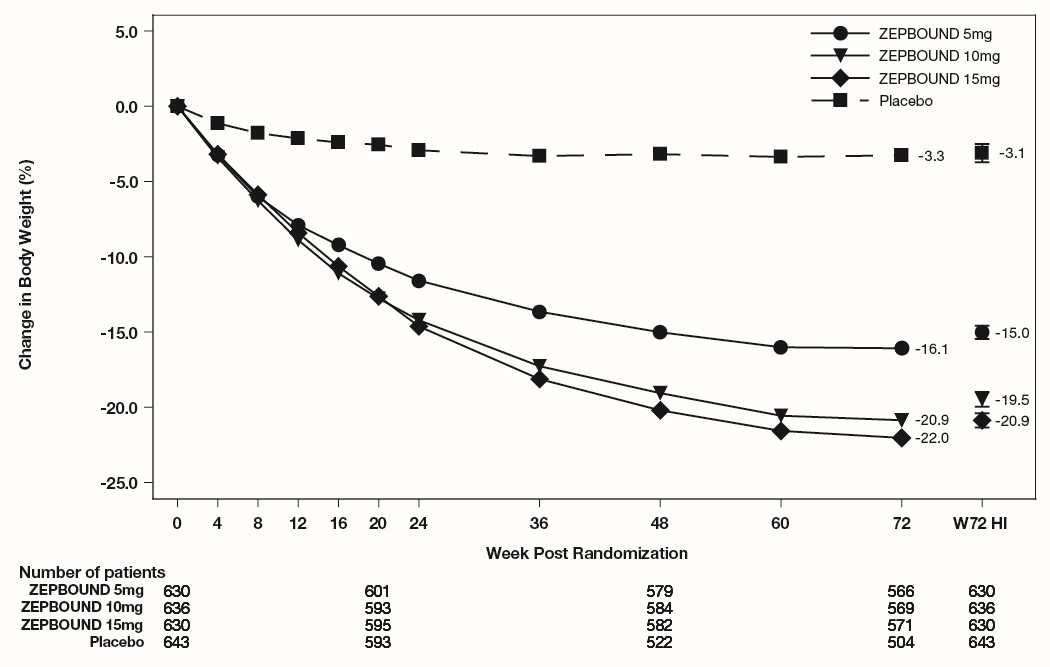
Mean reduction in body weight at week 72 in the 15 mg research group in SURMOUNT-1, compared with 3.1% in the placebo group.
| Trial measure | 5 mg | 10 mg | 15 mg | Placebo |
|---|---|---|---|---|
| Baseline | 0% | 0% | 0% | 0% |
| Week 72 | −15% | −19.5% | −20.9% | −3.1% |
At week 20 in SURMOUNT-1, the estimated mean change was −13.2 kg for the combined 10 mg and 15 mg groups and −2.5 kg for placebo. These figures are changes from each group’s starting weight. The registry reports the two tirzepatide groups together at this visit.
A later SURMOUNT-1 analysis included 1,545 tirzepatide participants with sufficient treatment exposure and available weights. Of the 278 who had lost less than 5% at week 12, 194 (70%) reached at least 5% loss by week 24. That 70% is a proportion of selected people who met a threshold. It cannot be used as the average percentage of weight lost.
In SURMOUNT-1 the mean changes were −15.0%, −19.5%, and −20.9% in the 5 mg, 10 mg, and 15 mg groups, respectively, versus −3.1% with placebo. Each percentage is relative to that group’s starting weight. Trial group labels are distinct from the total amount printed on a commercial pen.
SURMOUNT-1 enrolled 2,539 adults with obesity or overweight who did not have diabetes. FDA Table 2 reports the share who lost at least 5% of their starting weight by week 72. It was 85.1% in the 5 mg group, 88.9% in the 10 mg group, 90.9% in the 15 mg group and 34.5% with placebo. These are percentages of participants reaching a threshold.
SURMOUNT-2 enrolled 938 adults with overweight or obesity and type 2 diabetes. At week 72, the mean reductions were 12.8% in the 10 mg group, 14.7% in the 15 mg group, and 3.2% with placebo. This was a separate trial with different eligibility criteria.
SURMOUNT-3 randomized 579 adults who had already lost at least 5% during a 12-week lifestyle program. Over the next 72 weeks the tirzepatide group lost a further 18.4% from randomization, while the placebo group gained 2.5%.
In SURMOUNT-4, 670 participants were randomized after 36 weeks of open-label tirzepatide. Over the following 52 weeks, those who continued lost another 5.5% on average, while those switched to placebo gained 14.0%. Both figures use the week 36 weight as their starting point.
Only the 1,032 SURMOUNT-1 participants with prediabetes at entry contributed to the 176-week analysis. Their average changes were −12.3%, −18.7%, and −19.7% in the three active groups and −1.3% with placebo. Comparing these directly with the full 72-week cohort would mix populations.
In a SURMOUNT-1 substudy, 160 participants had usable body-composition scans at baseline and week 72. About three quarters of the weight lost was fat mass and one quarter was lean mass in both the pooled tirzepatide and placebo groups. Lean mass on a scan includes more than skeletal muscle.
A mean change describes the whole trial group. Some participants lost more weight and others lost less, even when assigned the same treatment. The percentage who reached a particular threshold answers a different question from the average change in weight.
Participants met specific entry criteria and received lifestyle support. Some discontinued treatment or missed a weight measurement, so the endpoint analysis also estimated missing outcomes. The trials evaluated the investigational products supplied by the study sponsor. They do not establish clinical equivalence for a Body Pharm pen.
Choose your starting weight and a published time point. Compare the recorded group averages in kilograms or pounds.
Average weight change
20.9%The 72-week endpoint covers all 2,539 randomized adults without diabetes. All groups received lifestyle support.
This is a mathematical illustration of a published clinical trial average, not a prediction of your personal results.
Selected group: 15 mg research group.
View the published resultsThe three molecules share a GLP-1 receptor target. Tirzepatide also acts on GIP, and retatrutide acts on GIP and glucagon receptors. A direct trial can compare molecules only in the population and under the conditions it studied.
| Feature | Tirzepatide | Retatrutide | Semaglutide |
|---|---|---|---|
| Drug class | Dual agonist | Triple agonist | GLP-1 agonist |
| GLP-1 receptor | Yes | Yes | Yes |
| GIP receptor | Yes | Yes | No |
| Glucagon receptor | No | Yes | No |
| Weight-management research | SURMOUNT program | TRIUMPH program | STEP program and SURMOUNT-5 comparator |
| Regulatory status | Specific products approved in the US and other markets | Investigational | Specific products approved in the US and other markets |
Semaglutide activates GLP-1 receptors. Tirzepatide also activates GIP receptors. Receptor activity explains how the molecules are classified. A clinical outcome requires direct measurement.
Retatrutide adds glucagon-receptor activity. The clinical doses, participant groups, and duration in its obesity trials differ from SURMOUNT-1. The direct trial of retatrutide against tirzepatide is TRIUMPH-5 (NCT06662383). Its registry reported no results at review in November 2026.
SURMOUNT-5 randomly assigned 751 adults with obesity without type 2 diabetes to tirzepatide or semaglutide. At week 72 mean weight change was −20.2% with tirzepatide and −13.7% with semaglutide. It was an open-label trial of the regimens tested and included no retatrutide group.
A 48-week phase 2 result and a 72-week phase 3 result come from different people, comparators, and analysis plans. Placing the percentages side by side cannot establish which drug would work better for the same person. SURMOUNT-5 supports a direct comparison for its two randomized groups.
Nausea, vomiting, diarrhea, and constipation are among the common side effects listed for Zepbound. The label also describes less common serious risks, including pancreatitis, gallbladder disease, and dehydration-related kidney injury. Hypoglycemia risk increases when tirzepatide is combined with insulin or medicines that stimulate insulin release.
Zepbound carries a boxed warning based on thyroid C-cell tumors observed in rats. Human relevance is unknown. A personal or family history of medullary thyroid carcinoma or multiple endocrine neoplasia type 2 is a contraindication.
FDA approvals name particular products, including Mounjaro and Zepbound. In Indonesia, BPOM lists Mounjaro KwikPen and a 2026 weight-management indication update. That assessment concerns the named product and registration holder. It does not identify either Body Pharm pen.
Use the 30 mg or 60 mg tab before opening a photo or document. The orange band, 60 mg label and report should all refer to the same format.


| Specification | Details |
|---|---|
| Product | Tirzepatide |
| Brand | Body Pharm |
| Format | Prefilled pen |
| Total per pen | 30 mg |
| Cap colour | Yellow |
| Price per pen | IDR 3,500,000 |
| Price per mg | IDR 116,667 |
| Storage on the label | 2–8°C, protected from light |


| Specification | Details |
|---|---|
| Product | Tirzepatide |
| Brand | Body Pharm |
| Format | Prefilled pen |
| Total per pen | 60 mg |
| Cap colour | Orange |
| Price per pen | IDR 5,400,000 |
| Price per mg | IDR 90,000 |
| Storage on the label | 2–8°C, protected from light |
The label gives a storage range of 2–8°C. Keep the carton away from light and the freezer. If it arrives warm or damaged, keep the packaging and contact the team before using it.
See the amount and price for each complete pen.
Tirzepatide is a peptide medicine that activates two hormone receptors involved in eating and glucose regulation. Named prescription products containing it have indications for type 2 diabetes and weight management. The clinical studies used specified formulations. The 30 mg and 60 mg numbers on this page identify the total stated contents of two Body Pharm pens.
Tirzepatide activates GIP and GLP-1 receptors. It helps the pancreas release insulin in response to elevated glucose, reduces glucagon secretion under those conditions, and slows stomach emptying. A controlled meal study also recorded lower food intake and less perceived hunger compared with placebo. These mechanisms help explain why both glucose and weight have been studied.
Yes, tirzepatide activates the GLP-1 receptor. A more precise description is a dual GIP and GLP-1 receptor agonist. Semaglutide is an example of a medicine that acts at GLP-1 receptors alone. The shared receptor accounts for some similarities, while the specific medicines have their own indications and trial evidence.
An agonist activates a receptor. Tirzepatide is a single molecule with activity at both the GIP and GLP-1 receptors. The hormones associated with these receptors help coordinate the body’s response to eating. “Dual” describes two biological targets. It does not refer to the two pen formats in this catalog.
Tirzepatide targets GIP and GLP-1. Semaglutide targets GLP-1. In the direct SURMOUNT-5 trial, the 72-week average reduction in body weight was 20.2% with tirzepatide and 13.7% with semaglutide. These results describe specific trial regimens in adults with obesity without type 2 diabetes. They cannot predict an individual response.
Retatrutide activates the glucagon receptor as well as the GIP and GLP-1 receptors targeted by tirzepatide. Retatrutide remains investigational. Specific tirzepatide products are approved for defined indications. Published results from their separate obesity trials cannot establish a head-to-head difference. The registered direct-comparison study is TRIUMPH-5.
SURMOUNT-1 and SURMOUNT-2 found greater mean weight loss with tirzepatide than placebo in people without and with type 2 diabetes, respectively. SURMOUNT-3 enrolled people who had already lost weight during a lifestyle program. SURMOUNT-4 tested continued treatment after an initial reduction and recorded substantial average regain among participants switched to placebo.
Mean reductions from starting body weight were 15.0%, 19.5%, and 20.9% in the 5 mg, 10 mg, and 15 mg research groups and 3.1% with placebo. The primary analysis covered 2,539 adults without diabetes, including people who discontinued treatment. Participants received lifestyle support in every group.
Digestive symptoms are common. The Zepbound prescribing information lists nausea, vomiting, diarrhea, constipation, and abdominal discomfort among reported adverse reactions. The label also discusses less common serious risks, including pancreatitis and gallbladder disease. The safety section and FDA label describe contraindications and the boxed thyroid warning for the approved product.
Yes, in specific prescription products. Mounjaro has indications in type 2 diabetes. Zepbound has indications for chronic weight management in qualifying adults and for moderate-to-severe obstructive sleep apnea in adults with obesity. FDA labeling for those products does not establish authorization or clinical equivalence for the 30 mg or 60 mg Body Pharm pen.
The yellow Body Pharm format is labeled 30 mg in total and the orange format 60 mg in total. Each has its own listed price and documentation. The larger stated content alone does not tell you the concentration, selector output, suitability, or duration for an individual. Compare the label and report for each format.
It is the amount of active ingredient the manufacturer states is in the whole pen. It is distinct from the quantity per unit volume, the amount delivered in an injection, and the labels used for trial groups. The 30 mg or 60 mg marking alone does not supply those other figures.
Body Pharm’s 30 mg certificate identifies lot C-Ti30-2.5-20250930. The separate 60 mg certificate identifies C-Ti60-3.0-20251010. Match the lot and format on your pack against the appropriate report. The manufacturer lists identity, purity, sterility, and endotoxin tests separately. These reports concern the tested samples. BPOM registration is a separate, product-specific record.
The manufacturer’s certificates for the pictured 30 mg and 60 mg formats specify 2–8°C in a sealed container protected from light, with no freezing. Verify the instructions and expiry on the exact supplied pack. Room-temperature allowances or in-use limits in a different manufacturer’s labeling apply to that particular presentation.
The references link to the original reports for SURMOUNT-1 through SURMOUNT-5. They also include the 176-week prediabetes analysis, the 24-week responder analysis, and primary studies of body composition and appetite. The SURMOUNT-1 registry lists the prespecified endpoints so readers can distinguish the main analysis from later subgroup work.
Mean changes in weight were −15.0%, −19.5%, and −20.9% in the three tirzepatide groups and −3.1% with placebo.
Read Original StudyMean weight changes were −12.8% in the 10 mg group, −14.7% in the 15 mg group, and −3.2% with placebo.
Read Original StudyFrom randomization, average weight change was −18.4% with tirzepatide and +2.5% with placebo.
Read Original StudyBetween weeks 36 and 88, the continuing group lost a further 5.5% on average and the placebo-switch group gained 14.0%.
Read Original StudyMean changes in body weight were −20.2% with tirzepatide and −13.7% with semaglutide under the assigned regimens.
Read Original StudyMean weight changes were −12.3%, −18.7%, and −19.7% in the three tirzepatide groups and −1.3% with placebo. The full 72-week trial population was larger.
Read Original StudyAmong those below 5% weight loss at week 12, 194 of 278 reached at least 5% by week 24. This is a responder proportion.
Read Original StudyApproximately 75% of weight lost was fat mass and 25% was lean mass in the pooled tirzepatide and placebo groups.
Read Original StudyParticipants receiving tirzepatide ate less at a test meal and reported less hunger and fewer food cravings than placebo participants.
Read Original StudyAt week 20 the pooled 10 mg and 15 mg groups lost an estimated mean 13.2 kg, compared with 2.5 kg on placebo. The 176-week weight endpoint applies only to participants with prediabetes at entry.
View the trial recordDescribes chronic weight management in eligible adults, the obstructive sleep apnea indication, common adverse effects, and the boxed warning.
Read the official informationSpecifies the approved uses in type 2 diabetes, including glycemic control and cardiovascular risk reduction for qualifying adults.
Read the official informationBPOM identifies the named product and registration holder. The entry does not identify a Body Pharm pen.
Open the Indonesian medicines registerThe comparison is retatrutide versus tirzepatide. The registry had no posted results at review in November 2026.
View the trial recordIdentifies semaglutide as a GLP-1 receptor agonist and gives the weight-management indication for authorized Wegovy products.
Read the official informationTell us how many Tirzepatide pens you want and where in Bali you are staying. We can confirm availability, the delivered price and a time that works for you.


